
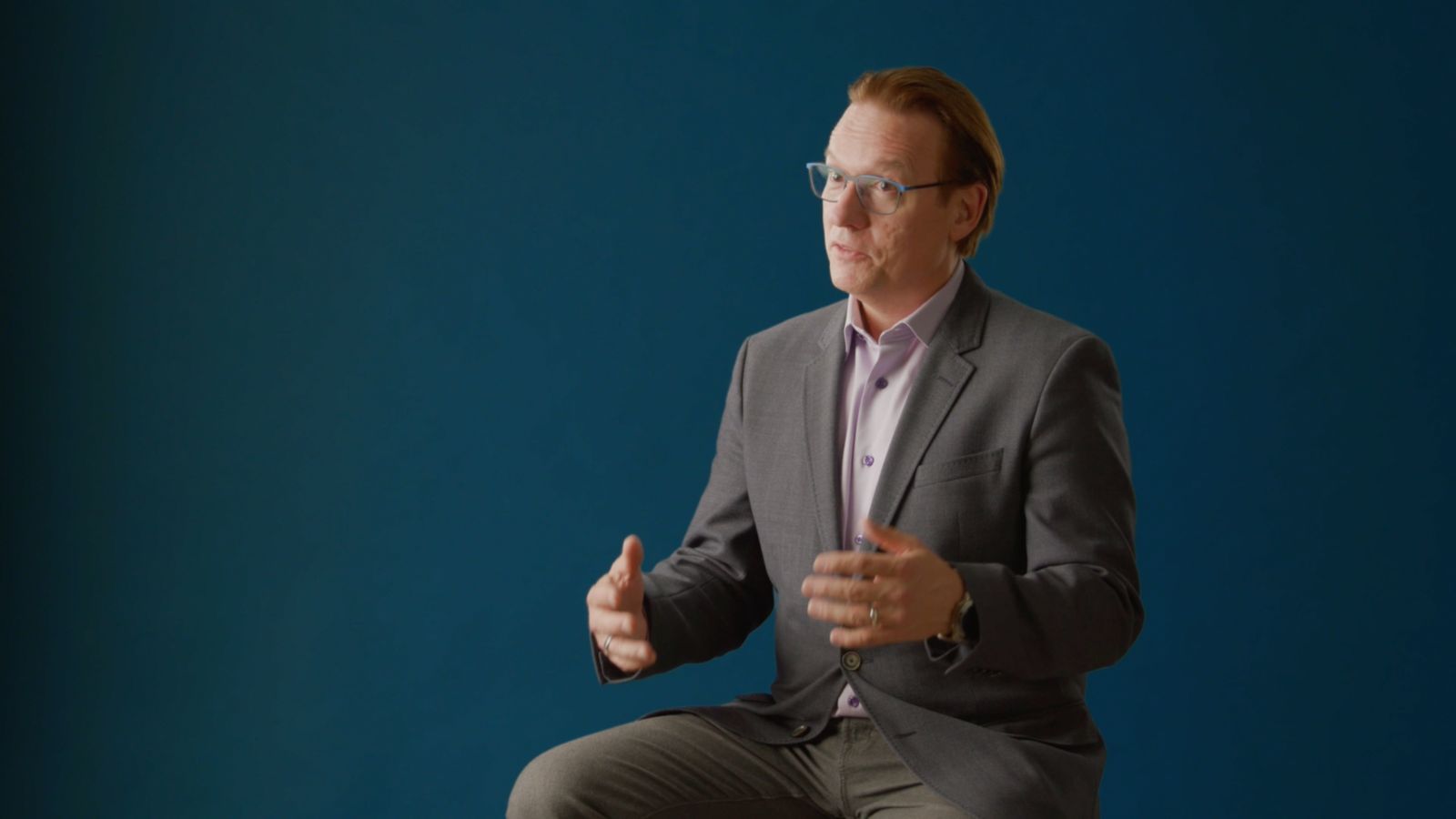
UPDATE (May 2026): Phil Wiser stepped down as Paramount CTO in May 2026 after seven-plus years. The interview below was conducted while Wiser was still in the role.
Flight Path is a Wing series for AI startup founders that draws on candid conversations with C-suite executives at leading corporations and unpacks what it takes to become a trusted AI partner in a variety of different industries.
AI may prove to be the most powerful tool Hollywood has ever encountered — if studios can figure out how to use it. At Paramount, CTO Phil Wiser's AI approach favors real adoption over demos and in-house knowledge over outside consultants. Tools that support the creative process — rather than shortcutting around it — earn his trust. From piloting AI across script workflows to imagining franchise-savvy creative assistants, Wiser is looking for startup partners who can deliver proven traction. For more on how enterprise AI adoption is evolving, see Wing's research on the state of AI in the enterprise.
Table of contents
- How AI is transforming the media industry
- A real problem ripe for outside help
- Buy versus build
- Early AI rollout mistakes
- Making AI truly useful to creators
- Where AI and media are heading
Key takeaways
- Adoption over demos: Paramount measures AI success through organic usage, not proof-of-concept count — startups should prove real workflow traction, not flashy prototypes. (See also: Walmart's AI playbook.)
- Partnership-first posture: The company prefers to buy off-the-shelf AI and reserves in-house builds for proprietary IP areas, which means most startup categories have a path in.
- Franchise-aware creative assistants: The highest-value AI opportunity Wiser sees is a tool that understands a franchise's full universe — characters, style, continuity — and supports creators in the room.
- Avoid the scattershot: Consulting-driven exercises that generated hundreds of use cases did not bear fruit; focused, user-driven pilots with real adoption metrics win.
- Support, don't replace: Tools that augment the creative process earn trust; anything that tries to shortcut around it does not. (See also: Politico's approach to AI.)
How AI is transforming the media industry
Q: What's your high-level view on how AI is transforming the media industry, and where startups fit in?
Phil Wiser: At Paramount, we've taken the approach to make AI available to all of our employees and encourage them to get training and really run the experiment. We asked, "If we empower and enable our entire workforce with AI, what interesting things could come out of that?"
We've made our creative community aware of this technology, we've given them access and training, and let them determine what makes sense in the creative process. We're learning organically that our creative community is adopting this in very novel, interesting ways, from how they process scripts to how they could do visual effects.
That's where the opportunity is: for tools that don't just check the AI box, but actually help people do their jobs better. AI is changing every layer of the business, from how we run operations to how we create content. The success stories aren't coming from demos or prototypes. They're coming from tools people actually use.
A real problem ripe for outside help
Q: What's a real problem inside Paramount that's ripe for outside help?
Phil Wiser: If we could build a tool for media franchises that really understood everything about the universe of a franchise and became another voice in the creative room as we're creating new content, that would be very powerful.
That is something we're striving toward: building all-knowing creative assistants working with the creators on a project. We have very large franchises, like Star Trek, SpongeBob, and others, and we continually create content around the same characters, in the same stylistic mode, and we also need the universe to be consistent.
It's aspirational, but I think it's a good model for a content company to move toward.
Buy versus build
Q: What kinds of AI tools do you buy, and where do you still build your own?
Phil Wiser: Our approach to AI has been to recognize that most of the investments we make today are going to be of no value very soon — the technology's just evolving so quickly. So we try to build only what we feel is necessary and leverage as much off-the-shelf technology as we can, at least in this phase of AI adoption.
The vast majority of AI consumption within the company will still be through third-party applications and through technology partnerships as the foundation. Even when we start building more, that build will be in very targeted areas. The way we take our intellectual property and apply AI to it is going to be a very proprietary capability that we want to keep in-house. We're going to be building more creative tools because we're finding that video generation is becoming much more feasible.
But most of the time, we're looking to partner.
Early AI rollout mistakes
Q: What mistakes did you make early on in your AI rollout — and what should startups learn from that?
Phil Wiser: Like a lot of companies, in 2023 we worked with big consulting firms to analyze hundreds of use cases and turn them into a seemingly infinite number of proofs of concept. That did not bear fruit. We did get a handful of those projects made into something meaningful, but I do not recommend a scattershot approach. You really have to be more thoughtful about where AI can have meaningful impact, and get a focus group of super-users to apply it to your business. A successful AI pilot is when people are actually using it, not a top-down initiative.
We measure success within the enterprise through adoption, because that means that we have success with those end users. It's when something is organically adopted that you see growth.
Making AI truly useful to creators
Q: What does it take to make AI truly useful to creators?
Phil Wiser: When they learn what it can't do, they develop trust and learn that this can be really useful for these things that augment what I'm doing in my creative process, but it's not going to, for example, convert a text prompt into a full television episode.
We're learning more and more that we can build around, for example, video generation foundation models to get outcomes that are more controllable and more in line with what our creative team needs in terms of editorial steering of the output.
Where AI and media are heading
Q: What excites you most about where AI and media are heading?
Phil Wiser: The main thing I'm excited about right now is the creative possibilities that I see in front of us, leveraging not just AI, but studio and cloud capabilities. We should get increased access to advanced visual effects, and advanced animation techniques.
I think the output of that is going to be more and more high-quality content at a higher rate.


